
I have recently written a piece on Zscaler, and I have now moved to AvePoint. The companies have some similarities, and I have delved into the more granular aspects of both companies. I thought it worthwhile to share my notes from this process, so other folks can get a better grasp on how this industry is layered.
This matters because I believe some of the best investment opportunities lie in this space. We are talking about companies growing revenues at 25% to 40%, with operating margins expanding, and this is showing in the stock price. AvePoint, for instance, is about to break its all-time highs.

Source: Author’s Summary
AvePoint vs. Zscaler: Solving Different Problems on the Same Map
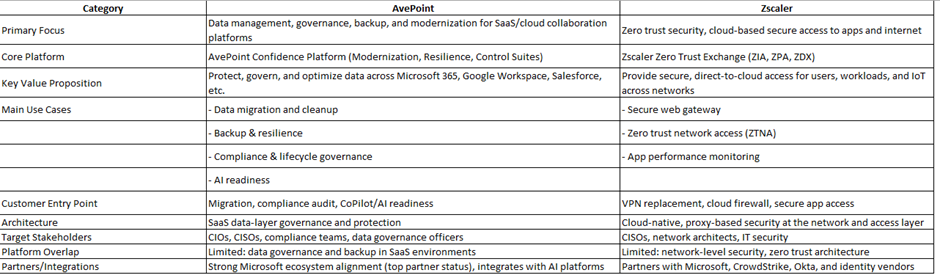
On the surface, AvePoint and Zscaler might seem like they’re playing in the same arena—security, cloud infrastructure, modern IT stacks. But once you dig in, it’s clear they’re not really overlapping. They’re solving different parts of the enterprise problem set: one’s focused on who gets in, the other on what happens once they’re in.
Zscaler is what most people think of when they hear “zero trust.” It’s network-level. Think secure access, VPN replacement, traffic inspection, cloud firewalls. It’s the digital bouncer: making sure users and devices connect to the cloud safely, no matter where they are. Everything routes through their proxy layer, so access is tightly controlled and threats are stopped before they hit anything important.
AvePoint, by contrast, doesn’t deal with the network. It’s all about what’s inside the apps. Once you’re in Microsoft 365 or Salesforce, it manages the mess—files, permissions, lifecycle policies, compliance controls, backups, all the governance stuff that usually gets ignored until someone loses data or fails an audit. It’s not flashy, but it’s foundational.
Where They Fit in a Modern Stack
Here’s one way to think about it. Zscaler keeps the doors secure. AvePoint cleans the house and locks the filing cabinets. You’d use Zscaler to make sure only authorized users can connect to your environment. You’d use AvePoint to make sure those users don’t accidentally (or intentionally) share sensitive data with the wrong people, store things improperly, or blow past retention rules.
They’re layered, not redundant. A company deploying Microsoft 365 might use Zscaler to route user traffic securely, while using AvePoint to track who’s accessing what within Teams, SharePoint, or OneDrive—and whether the data itself is governed the way it should be.
They Might Sound Similar, But They’re Built for Different Teams
Zscaler is a CISO’s tool. It’s for security teams thinking about network architecture and threat posture. AvePoint speaks more to CIOs, governance leads, and compliance officers—the people who get called when there’s a data loss incident or a regulatory checklist to complete.
Their buying centers don’t usually cross, which is why they rarely compete. In fact, in some environments, they both get bought—because one doesn’t replace the other. They’re solving different problems, just adjacent ones.
Source: Author’s Summary
Riding the Same Waves—Differently
What’s interesting is that both companies are riding the same market tailwinds. Everyone’s adopting AI, everyone’s dealing with hybrid work, and zero trust is more than just a buzzword now. Zscaler makes sure AI tools are delivered securely and users don’t bring risk in with them. AvePoint ensures the data AI tools rely on is accurate, governed, and usable.
So yes, they’re both part of the modern IT stack. But they’re sitting on different floors of the building.
Market View: Two Different Games
From a business standpoint, Zscaler’s in a different weight class. They’re heading toward $2.5B+ in ARR, growing fast, and competing with giants like Palo Alto Networks and Cisco. AvePoint is smaller—approaching $400M ARR—but it’s growing steadily, profitably, and carving out its own lane in governance, data lifecycle, and AI readiness. Their competitors look more like Rubrik, Varonis, and Cohesity.
Even financially, their models tell different stories. Zscaler spends big to grow and dominate market share. AvePoint plays it a bit more conservatively: 75% gross margin, ~15% operating margin, and a channel-led model that gives it leverage without bloating the cost structure.
Final Thought: Different Problems, Same Enterprise
You don’t pick between AvePoint and Zscaler. You pick both—if you’re serious about modern IT. One protects the roads into your cloud. The other makes sure the data living there is actually usable, secure, and compliant.
So, no—they’re not overlapping. They’re complementary. And if you’re building an AI-enabled, zero-trust digital workplace, you’re probably going to need both sooner than you think.





 Investment Gems
Leave a comment