The market is testing a new narrative for $NVDA. This will be a bull and bear ferocious fight, but the current bear thinking is the following:
1. Overcapacity Risk in Semiconductors: The AI Bubble Narrative
Key Issue: Overinvestment Based on Overhyped Demand
NVIDIA’s meteoric rise has been fueled by the generative AI boom, but history shows that tech hype cycles often result in overcapacity (e.g., dot-com bubble, cryptocurrency mining GPUs).
Revenue from Data Center GPUs accounted for 87% of total revenue in Q3 FY2024, making NVIDIA heavily reliant on AI demand continuing indefinitely.
A 10% slowdown in AI investments or hyperscaler spending (e.g., Microsoft, Amazon, Google) could drastically impact NVIDIA’s revenue.
Overcommitted to Supply: NVIDIA has locked in $28.9 billion in supply commitments, expecting ongoing high demand for its Hopper and Blackwell architectures.

If demand slows or product transitions are delayed, these commitments could lead to massive inventory write-downs, hurting margins.
Why It Matters for a Short Thesis:
The semiconductor market is notoriously cyclical. Any downturn in demand could expose NVIDIA to falling prices, unsold inventory, and margin compression. Overcapacity could turn into a pricing war with competitors like AMD and Intel, further eroding profitability.
2. NVIDIA’s Dependence on Hyperscalers and China
Key Issue: Revenue Concentration in Fragile Markets
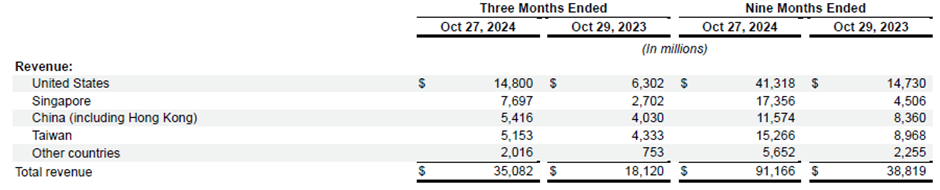
NVIDIA’s largest customers, such as Amazon, Microsoft, and Google, account for a significant portion of its revenue. If even one reduces AI-related spending due to budget cuts or cost discipline, the effect on NVIDIA would be severe.

15% of NVIDIA’s Q3 2024 revenue came from China and Hong Kong. Tightened U.S. export restrictions on advanced chips to China could shrink this critical market further. If restrictions extend to Blackwell chips (NVIDIA’s next-gen architecture), this could limit growth and lead to unsold inventory.
Why It Matters for a Short Thesis:
Geopolitical risk combined with hyperscaler reliance creates an unsustainable revenue model in a downturn. NVIDIA’s revenue base might not be diversified enough.
3. Valuation Disconnect: Growth Premium Priced for Perfection
Key Issue: An Unsustainable Price-to-Sales (P/S) Ratio

NVIDIA’s stock trades at a forward P/S ratio far above industry peers, priced as if AI adoption will grow exponentially for years. This valuation leaves little room for error:
Market expectations assume continued exponential growth in AI-related revenue. Any sign of slowing demand or margin compression could cause a violent repricing of the stock, as investors adjust to more realistic growth assumptions. The market isn’t pricing in the risks of:
AI demand plateauing.
Cyclical overcapacity in GPUs.
Geopolitical and competitive pressures.
Why It Matters for a Short Thesis:
NVIDIA’s valuation could collapse under its own weight if the AI hype cycle wanes or fails to deliver on promises.
4. Structural Weaknesses in Business Model
Key Issue: Dependence on High Margins and R&D Investments
NVIDIA has exceptional gross margins (~74.5% in Q3 FY2024), but these margins are vulnerable to:
Increased competition from AMD, Intel, and emerging players.
Overcapacity, leading to price wars.
Rising R&D and supply costs to maintain its technological edge.
R&D Bloat: R&D spending has ballooned to $9.2 billion for FY2024 (up 48% YoY).
If AI demand falters, these costs become unsustainable.
Product Transition Complexity: NVIDIA’s accelerated product cadence (e.g., Hopper, Blackwell) increases risks of inventory obsolescence, supply chain inefficiencies, and customer confusion.
Why It Matters for a Short Thesis:
Any disruption in high-margin segments or R&D inefficiencies could create cascading financial problems for NVIDIA.
Catalysts for the Short Thesis
Demand Plateau: AI adoption slows as hyperscalers optimize costs and customers hesitate on ROI for generative AI investments.
Geopolitical Restrictions: Escalating U.S.-China tensions lead to further export bans, limiting NVIDIA’s market.
Earnings Miss: A single revenue or margin miss due to overcapacity or demand shortfall could trigger a rapid market repricing.
Valuation Correction: Investors may rotate out of “story stocks” like NVIDIA during a broader market downturn.
Impact on thesis
I am not really picking on this whole battle, I am only trying to collect my thoughts and understand what the emerging side (bears) is seeing. I think the previous paragraphs capture it well. Going forward the DeepSeek developments will likely hang over NVIDIA. The cost efficiency argument on the surface means that AI models require fewer GPUs per training cycle and given that Hyperscalers optimize for cost savings, we can see them reducing total spending on NVIDIA’s chips sometime in the near future. Even a small reduction vis-a-vis expectations can drive a brutal repricing of the company’s valuation.
Nevertheless, I think that the Jevons Paradox will prevail in the long term. As AI model training becomes cheaper, demand for NVIDIA GPUs will increase not decrease. The expanded accessibility and new use cases will likely make it happen.
That said it is important to understand that there is likely to be turbulence as market participants try to digest this important piece of news. There will likely be moments of violent re-pricings at some of the next few quarterly earnings calls if there is any hint of spending cuts by Hyperscallers. I recommend keeping an eye on hyperscalers’ CapEx, if they reduce total spending NVIDIA might be hit. Also, keep an eye on abnormal price cuts in GPUs. Both can be a flag for margin compression. In my opinion, this can turn out to be a buying opportunity if the Jevons Paradox holds. At this moment I think it will, but it will be critical to correctly frame the time horizon for these swings.
Disclosure: This text expresses the views of the author as of the date indicated and such views are subject to change without notice. The author has no duty or obligation to update the information contained herein. Further, wherever there is the potential for profit there is also the possibility of loss. Additionally, the present article is being made available for educational purposes only and should not be used for any other purpose. The information contained herein does not constitute and should not be construed as an offering of advisory services or an offer to sell or solicitation to buy any securities or related financial instruments in any jurisdiction. Some information and data contained herein concerning economic trends and performance is based on or derived from information provided by independent third-party sources. The author trusts that the sources from which such information has been obtained are reliable; however, it cannot guarantee the accuracy of such information and has not independently verified the accuracy or completeness of such information or the assumptions on which such information is based.






 Investment Gems
Leave a comment