
I’ve been looking at my clustering stock screener, and I think it is giving us a much more interesting macro signal than simply “energy stocks are strong.” The obvious read is scarcity. Roughly a third of the portfolio sits across refiners, E&P, oil services and midstream. Even adjacent uranium stories like Denison Mines (DNN) are having a field day. Add machinery, gold, shipping and materials and more than half the book is tied in some way to physical assets, commodities or real-world capacity. But I think stopping there misses the point.
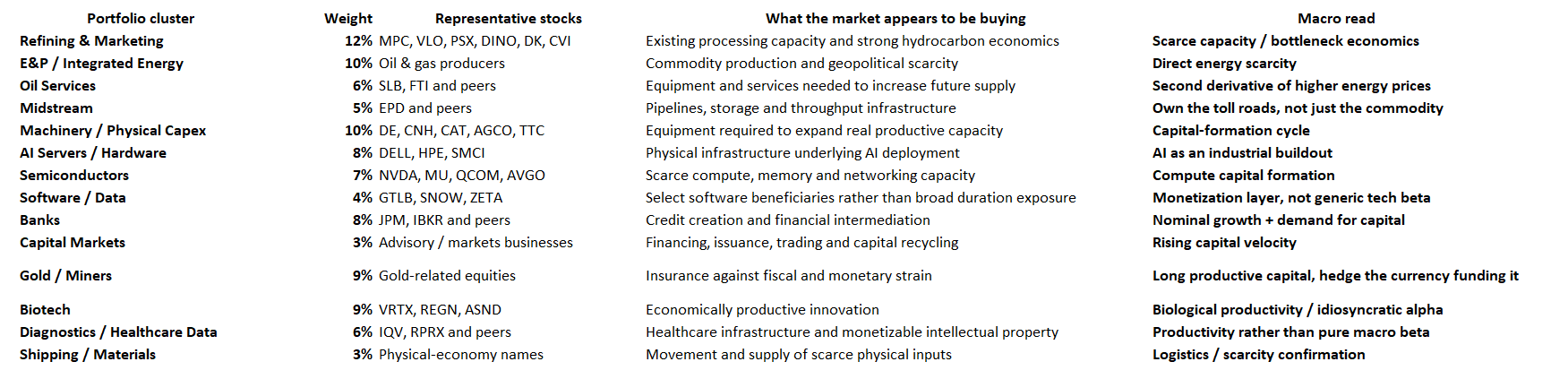
What jumps out is that the portfolio is not simply long commodities. It is long capital intensity. Refiners are strong, oil services are strong, midstream is strong, Deere, CNH, Caterpillar and AGCO are strong, AI servers and semiconductors are strong, and banks and capital-markets businesses are showing up too. These things look unrelated if you organize the market by sector. They look much less unrelated if you organize the market by what they actually do. They all sit somewhere in the process of turning capital into productive capacity. That may be the actual trade.
The useful way to read this is to start with the stocks, look at what is clustering, and ask what hidden variable could be pushing all of them at the same time. Right now the hidden variable looks something like scarcity, capital demand and nominal growth. That is a very different regime from the one investors got used to during the 2010s. For years, the best businesses were capital-light. Software, platforms, digital advertising, marketplaces. Marginal costs were low, physical capacity was abundant enough that nobody really cared about it, energy was cheap and money was cheap. You could almost treat the physical economy as plumbing. That world seems to be changing. AI alone is forcing an enormous amount of capital back into the physical economy. Data centers need servers, networking, cooling, power generation, transformers, transmission infrastructure, land and financing. At the same time, the energy system itself is constrained, industrial capacity has become more valuable, agricultural machinery is showing strength, governments are spending more on defense and infrastructure, and companies are spending more on compute. The economy is becoming capital hungry again.
That is why something like Deere and Dell showing up in the same factor portfolio is much more important than it looks. One builds machines for farms and construction. The other builds machines for data centers. Different sectors, same macro function. They sell expensive equipment to customers trying to increase productive capacity. That is capital formation. The energy side reinforces this, but there is a subtlety that matters. The biggest energy expression is way more nuanced than simply upstream oil producers, and the key is refiners which look extremely prominent. Then you get exploration and production, then oil services, then pipelines. That looks like the market rewarding the entire infrastructure required to move hydrocarbons through the economy. Production, transportation, processing, refining, services. That starts looking like a bottleneck trade. If the only thing happening were a geopolitical oil premium, you would expect crude sensitive producers to dominate everything else. But when refiners, services and infrastructure all participate, the market may be saying something broader: capacity itself has become scarce.
This also makes the machinery signal particularly interesting. Deere, CNH, Caterpillar, AGCO. These are not geopolitical trades. A missile can move Brent overnight. It does not normally create a persistent bull move in farm and heavy machinery. Machinery starts to matter when investors believe somebody is going to spend money, build something, replace equipment, increase output, expand capacity. Energy is the first derivative of scarcity. Machinery may be the second derivative. The first move says the existing supply of something is valuable. The second move says somebody is eventually going to spend money trying to produce more of it. If the machinery stocks continue strengthening even after the immediate geopolitical scarcity premium eventually comes out of oil, that would be one of the strongest confirmations we could get that this is becoming something much larger than an oil trade.
The AI side is saying essentially the same thing. What I find fascinating is that the AI exposure is heavily tilted toward hardware and semiconductors, with a much smaller allocation to generic software. That distinction matters. The portfolio is saying AI capital formation is strong. Servers, GPUs, memory, networking, compute infrastructure. Again, physical capacity. This is why I increasingly think the old distinction between “technology” and “the physical economy” is becoming less useful. AI looks digital on the surface, but underneath it AI is one of the most capital-intensive industrial buildouts we have seen in decades. Electricity, gas, copper, cooling, transformers, concrete, servers, networking, financing, labor. The supposedly digital boom is creating enormous demand for very non-digital things. Capital gets deployed into compute infrastructure, then into energy infrastructure, then into industrial machinery, then into logistics, and the financial system earns money intermediating all of it.
The financial exposure is easy to overlook, but I think it is one of the most important pieces of the puzzle. Banks and capital-markets companies are participating alongside energy and machinery. Look at the last few months of Atlanticus Holdings (ATLC) perfromance. That makes the macro message harder to classify as simple stagflation. A really ugly stagflation regime is not necessarily great for financials. Credit deteriorates, activity slows and eventually high rates become destructive. But energy plus machinery plus financials starts to look different. It looks more like high nominal growth combined with strong demand for capital. That may also help explain why long rates remain so stubbornly high. Most investors instinctively interpret high rates as monetary restriction. But there is another possibility. What if equilibrium rates are higher because the economy suddenly has a lot more things worth funding? AI data centers, power generation, grid investment, industrial reshoring, defense, infrastructure, energy production. If investment demand structurally rises, capital itself becomes more valuable. Some portion of higher long-term yields may therefore not be telling us that the economy is dying. It may be telling us that the economy has become capital intensive again.
Gold initially looks strange next to machinery, banks and AI infrastructure, but I actually think it fits. You can be long productive capital and still be worried about the monetary system being asked to finance too much of it. Governments are borrowing heavily, companies are investing heavily, AI infrastructure may require trillions, energy infrastructure requires enormous spending, defense spending is rising and fiscal deficits remain large. That creates a strange but coherent portfolio: own the assets and businesses benefiting from capital formation, while keeping insurance against monetary or fiscal instability. Gold fits naturally into that role. Healthcare is another large block, and I would be careful about forcing a macro explanation onto all of it. Some of that is simply idiosyncratic alpha. But even there, the exposure is interesting because it is not dominated by lottery-ticket biotech. It leans more toward companies where innovation is actually becoming economically productive. Twist Biosciences (TWST) is a great example of that. You could almost think of the whole portfolio as owning different forms of productivity: machinery improves physical productivity, AI improves informational productivity, biotechnology improves biological productivity.
What gives me more confidence in the broader macro interpretation is that this signal is not appearing in isolation. When I look across different screeners, several of the same companies keep showing up under very different methodologies. Deere. CNH. Marathon Petroleum. Valero. Dell. GitLab. Vertex. The models are looking for different things: trend persistence, breakouts, technical leadership, macro sensitivity, momentum, quality. And yet they are converging on a surprisingly similar set of underlying themes. That matters. If several independent models arrive at roughly the same answer, I become much more interested in the common factor underneath them. The common factor does not seem to be “buy inflation.” It looks closer to “buy productive capacity.”
This is why I would describe the regime now as Scarcity Reflation transitioning into Capital Formation. Scarcity may have been the trigger, but capital formation could become the more durable second act. That distinction matters enormously for how I want to manage the portfolio. If the whole thesis requires Brent at $100, then it is not a capital-formation thesis. It is an oil shock trade. The real test comes when the geopolitical premium eventually disappears. Imagine some Iran agreement gets done and oil drops toward $60. EQNR probably gets hit, tankers probably get hit, fertilizer scarcity may unwind. Fine. But what happens to Deere, CNH, AGCO, Dell, the banks, the AI infrastructure names? That is the experiment I care about. If oil falls sharply and those groups continue making highs, then we learn something very valuable. The market was not simply buying scarcity. It was buying the response to scarcity: investment, capacity, productivity, capital formation.
If instead oil falls and machinery, banks, semiconductors and AI hardware collapse at the same time, then we have to admit that a much larger percentage of the move was one correlated nominal-growth/scarcity factor than we thought. The same applies to financials. If long yields remain elevated but banks and capital-markets companies begin breaking down, that tells us the price of capital has moved from healthy because investment demand is strong to destructive because financing conditions are strangling activity. If energy keeps going higher while Deere and CNH lose relative strength, that would also be a warning. It would say scarcity remains, but the economy is not responding with investment. That is a much uglier regime.
For now, though, the evidence looks more constructive. The market appears to be rewarding the infrastructure required to produce more energy, more food, more compute and more industrial output. And that may be the most important change happening beneath the surface. For the last fifteen years, investors were trained to think the future belonged to companies that needed almost no physical capital. Maybe the next cycle belongs, at least partly, to the people who own the things everybody suddenly needs to build: machines, power, compute, pipelines, factories and financing. The numbers seem to be arriving at that story before the story has fully become consensus. And if the energy scarcity premium eventually disappears while the rest of this structure keeps strengthening, I think we may eventually stop calling this Scarcity Reflation. We might simply call it what it is: a capital formation cycle.





Leave a Reply