
Something rather interesting is happening underneath the stock market. The AI trade has been absolutely massacred, energy and basic materials are rolling over, and the businesses that do not need another few billion dollars of financing are quietly outperforming. Meanwhile oil is falling, inflation remains uncomfortable, and long term rates are still making life miserable for anyone trying to finance productive capacity.
The emerging picture reminds me of several historical episodes, but none fits perfectly: 1998 style forced deleveraging, a 2000 like investment-cycle repricing, a 2022 duration shock, and perhaps a late 2018 style monetary turning point.
A 2022 style monetary squeeze on a 2000 style investment boom, intensified by 1998 style selling. The open question is whether falling oil eventually produces a 2019 style improvement in credit.
1 | What the stocks are telling us
Start with returns rather than a good story. By November 16, capital intensive AI and commodity-linked groups remained badly damaged while utility shares, select cash-generating software businesses, and market infrastructure held up. These are equal-weighted medians, not index returns or measures of intrinsic value.
| Sector | 1-month median | 1-quarter median |
| Basic Materials | -10.7% | -16.4% |
| Technology | -4.6% | -9.4% |
| Energy | -8.9% | -8.4% |
| Industrials | +0.6% | -8.0% |
| Financial | +2.2% | -6.7% |
| Consumer Cyclical | +3.6% | -2.4% |
| Consumer Defensive | +3.3% | +1.6% |
| Utilities | +5.2% | +0.7% |
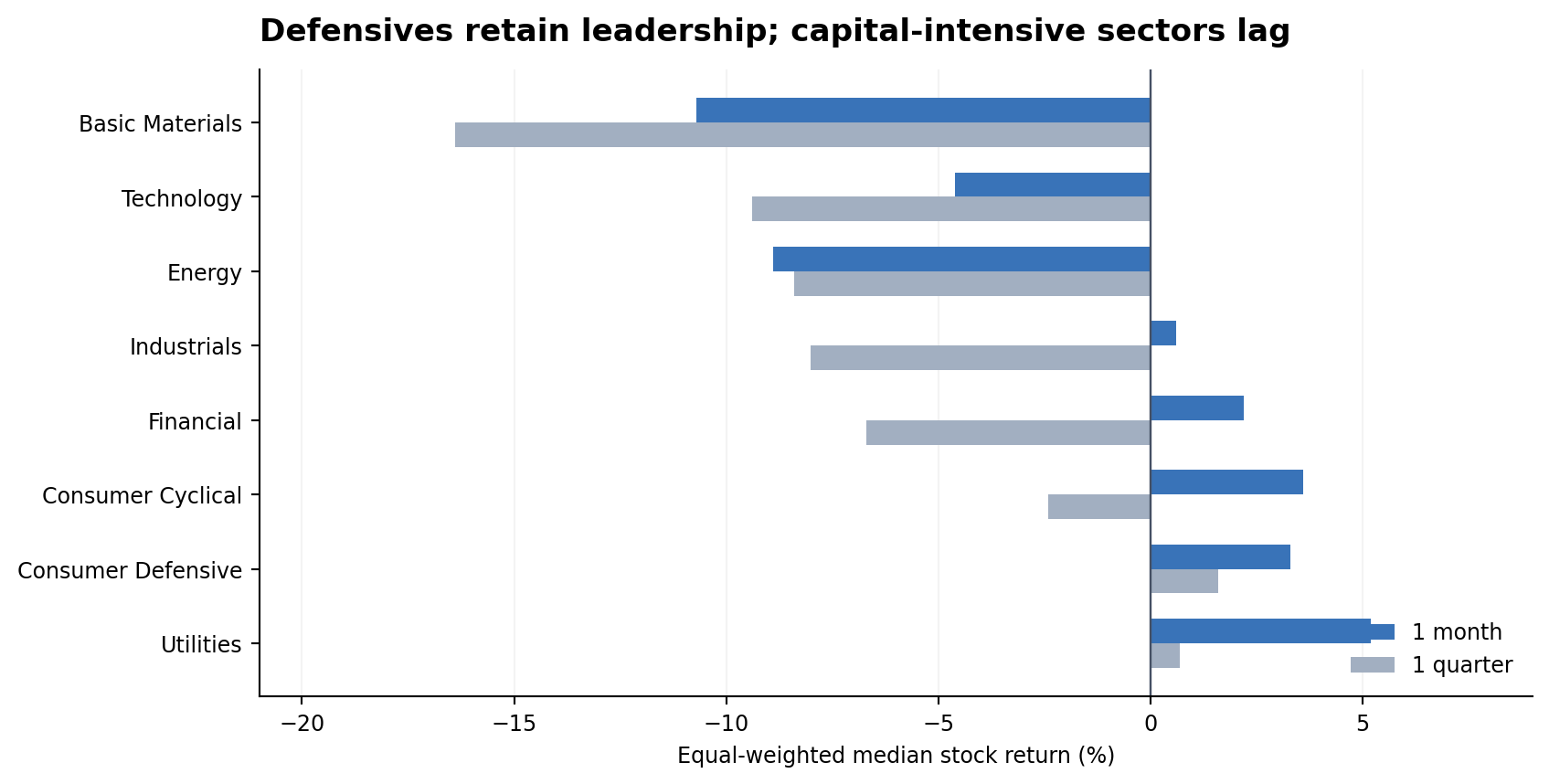
Figure 1. November 16 snapshot (2,739 tickers). Returns are trailing.
The market is not rejecting all growth. It is discriminating between growth that can be monetized from an existing capital base and growth requiring enormous fresh investment before the cash starts arriving. And the November 12 AI rebound tells us how violent repositioning can be.
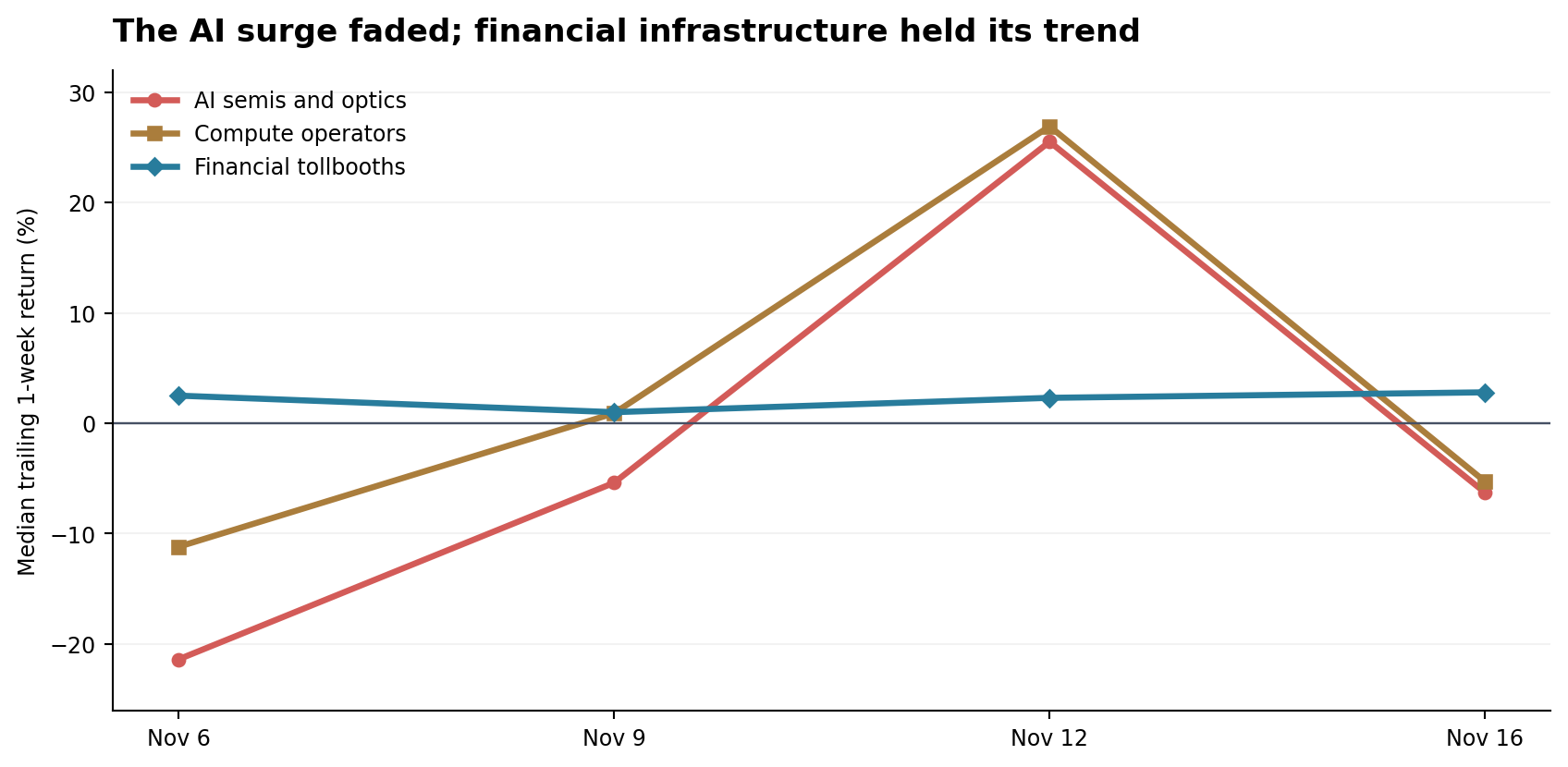
Figure 2. Fixed ticker baskets across November 6, 9, 12 and 16. Each point is a rolling weekly return, not a point-to-point investment return.
AI semiconductor and optical names reached a +25.5% median trailing-week return on November 12. By November 16 that median was -6.3%. Compute operators moved from +26.9% to -5.3%. Financial tollbooths never produced a similar spike, but held positive weekly trends throughout. A big green candle is not evidence that a financing cycle has restarted.
2 | The historical mechanisms: four similar-looking crises, very different endings
| Analogue | What broke | What changed the outcome |
| 1998 / LTCM | Funding liquidity, leverage and crowded positions | Fed cuts and normalization of market plumbing |
| 2000–02 / Telecom | Excess capital spending and disappointed returns | Demand and profitability had to catch up with capacity |
| 2018–19 / Policy pivot | Higher financing costs, weaker oil and risk appetite | Fed became patient; credit and equities recovered |
| 2022–23 / Duration shock | Inflation and discount-rate repricing | Profitable, balance-sheet-strong technology led selectively |
1998: When the plumbing breaks
Russia defaulted, LTCM imploded, leveraged trades unwound, and the market rediscovered that liquidity is a very unreliable friend. The Fed cut rates three times between September and November 1998 and the technology boom later resumed. The comparison today is the violence of the liquidation—not evidence of an equivalent systemic crisis or policy rescue. We have a crowded trade being unwound, but not necessarily the cuts that rescued risk appetite in 1998.
2000: The technology can win while shareholders lose
The internet was real. So was demand for connectivity. Unfortunately that did not mean investors financing vast telecom networks earned attractive returns. Borrowing expanded, capacity overshot what customers could monetize, and funding dried up. AI is now facing a version of the same question: can operators earn attractive returns after interest, depreciation, power, networking and continual hardware refresh? Unlike 2000, large hyperscalers now provide substantial self-funded demand, and some projects have customer prepayments. The outcome is not predetermined.
2022–23: Profitable growth survives expensive capital
Inflation crushed long-duration valuations in 2022. Yet profitable technology leadership reappeared in 2023 while money was far from free. That creates an alternative to a broad Fed rescue: exceptionally valuable AI workloads might justify investment even at elevated rates, but only for projects with real customers, attractive unit economics and executable financing.
Late 2018: The missing policy pivot
Oil dropped, growth fears rose, markets sold off and the Fed shifted toward patience in early 2019. Something similar could develop if inflation cools without demand deteriorating. But today the inflation backdrop is harder: a falling crude price is not sufficient proof that cheaper capital is coming.
3 | The macro hinge: oil, inflation, yields and credit
As of the most recent observations considered in this piece, Brent settled November 18 at $91.95. October US headline CPI was up 0.4% month over month; the US 10-year yield was approximately 5.1%; and the US high-yield option-adjusted spread was 343 basis points on November 17. These snapshots belong to different dates and should not be treated as a synchronized intraday reading.
| Variable | Latest observation | What it tells us |
| Brent crude | $91.95 (Nov 18 close) | Energy pressure easing, but supply and demand causes differ |
| US CPI | +0.4% m/m (October) | Not yet unambiguous inflation relief |
| US 10-year yield | ~5.1% (Nov 17–18) | Long-duration capital remains expensive |
| US HY credit OAS | 343 bp (Nov 17) | Risk capital is priced above the sovereign rate |
The central issue is not whether oil falls. It is *why* it falls and what credit does next. Falling oil from supply normalization is an entirely different investment backdrop from falling oil caused by contracting demand. The former can improve corporate margins and household purchasing power; the latter can coincide with a recession and a wider credit premium.
| Cross-asset combination | Primary read-through |
| Oil down · Yields down · Credit spreads down | Constructive disinflation and financing relief |
| Oil down · Yields down · Credit spreads up | Demand scare: a lower risk-free rate is not cheaper project finance |
| Oil down · Yields up · Credit spreads up | Persistent inflation/term-premium pressure despite oil relief |
| Oil up · Yields up · Credit spreads up | Renewed supply shock and capital crowding-out |
4 | Four possible endings for the next 18 months
| Scenario | Macro path | Likely relative winners | Confirmation |
| 1998 / 2019 recovery | Oil & inflation ease, yields and spreads fall | AI semis, optical, financed operators, industrial suppliers | Financing closes; broader industrial participation |
| 2023 selective boom | Rates high, credit selective; demand strong | Capital-efficient silicon, cash-rich hyperscalers, software | Bookings and ROI strengthen despite expensive money |
| 2000 / 2016 capex bust | Oil & yields fall on weak demand; spreads widen | Defensive cash flows, exchanges, selected health | Orders and utilization fall; cancellations spread |
| 2022 stagflation relapse | Energy and inflation rebound; rates rise | Select existing scarcity assets | Energy shock plus rising real yields |
These paths can happen sequentially rather than simultaneously. A liquidity flush can provoke policy easing. An investment boom can fail and make the surviving projects stronger. A nominal-growth rebound can become an inflation shock if energy bottlenecks recur. Historical analogues are mechanisms, not scripts.
5 | What the bottom-up evidence confirms—and what it does not
The current performance currently supports selective capital rationing. Technology and basic materials have poor longer-window breadth. AI suppliers staged enormous short-lived recoveries, while financial infrastructure and selected productivity software held better positive multi-period trends. That does not prove a recession, a dollar shortage or a telecom-style overbuilding cycle. Nor does it prove that a 1998-style rescue is imminent.
In particular, the broad high-yield spread at 343 basis points does not look like a systemic 2015–16 credit panic. The funding problem may be much more concentrated in the companies trying to build tomorrow’s compute capacity. We need sector-specific issuance, terms and commissioned returns to establish that mechanism.
6 | The test that would change my mind
| Indicator | Constructive evidence | Warning evidence |
| Oil & refined products | Supply normalization with demand holding | Prices fall because activity contracts |
| Core inflation & real yields | Disinflation lowers real funding costs | Sticky inflation keeps rates restrictive |
| Credit spreads & issuance | Projects fund at workable spreads | Widening spreads, cancellations, dilution |
| AI orders & utilization | Bookings convert into profitable cash flow | Backlog does not become economic earnings |
| Industrial and AI breadth | Positive monthly and quarterly participation | Repeated violent rallies followed by lower lows |
For me, the strongest constructive signal would be oil and refined products normalizing, core inflation cooling, credit spreads narrowing, and semis plus electrical equipment developing persistent monthly leadership. If oil falls while credit widens and supplier orders weaken, the 2000 analogue starts looking much less theoretical.
7 | The conclusion: history gives us mechanisms, not scripts
The market is asking investors to distinguish a technological revolution from the financing structure erected around it. Artificial intelligence can transform the world while substantial parts of its first investment boom destroy shareholder value. Equally, a forced liquidation can produce exceptional opportunities if demand remains strong and financing becomes executable again.
The fractal turns not when oil falls, but when lower energy costs finally become lower financing costs without dragging demand down with them.
That is the moment when today’s capital-rationing regime could become tomorrow’s productive-investment bull market. And if history is any guide, the market probably will not send a polite invitation.






Leave a Reply