The index did nothing for two weeks. Underneath it, money fired every long-duration haven and bought small banks and energy. The bond curve and the commodity tape say it was a supply shock wearing a reflation costume. Here’s the tell, and why the difference is the whole trade. Druckenmiller has this line I keep coming back to, that the stock market is mostly a sideshow.
The real information is in the bond market and the commodity tape, because that’s where the big, slow, liquidity-driven money actually votes. The equity index is the headline. The curve and the crude print are the story.
The last two weeks are a clean little lesson in that, including a lesson for me. If you only watched the S&P you saw nothing. SPY down 0.8%, the Nasdaq down 1.9%, small caps down 1.3%. A summer drift. But I run a screen across thousands of names and track the cross-asset tape underneath it every day, and under that flat surface the money moved hard and fast. It sold every duration sensitive haven and bought the rate-and-cycle-sensitive value complex. Banks and energy up, bonds and gold and biotech down.
The one group that lit up, and the ETF that hid it
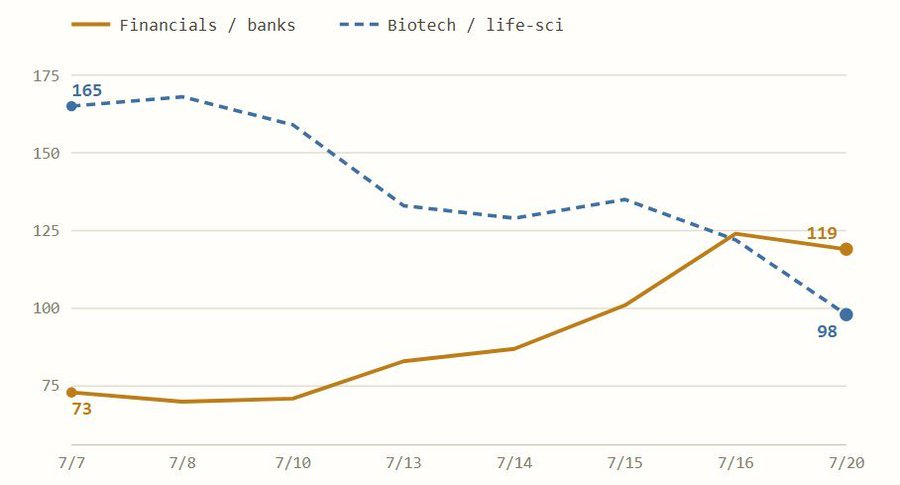
Start with the finding, because it’s real regardless of what’s driving it. My leadership screen, the count of names in a confirmed uptrend near highs with genuine relative strength, went from 73 financials on July 7 to 119 on July 20. Almost a straight line. Nothing else in the market did that. And it wasn’t the same names hanging around, 57 of the 119 were brand new leaders. Fresh money.
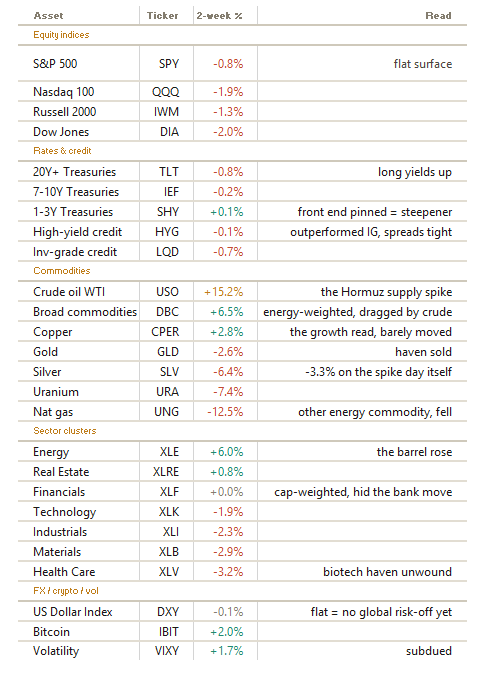
Here’s the Druckenmiller detail I love. If you’d checked XLF, the financials ETF, you’d have seen it dead flat over the same two weeks. Plus zero percent. Because XLF is cap-weighted, so it’s really JPMorgan, Berkshire, Visa and Mastercard, and those went sideways. The move was in the small stuff. Of my 119 leaders, about 97 are regional and community banks and thrifts. The equal-weight reality and the cap-weighted ETF were telling opposite stories, and the ETF was lying to you. So something lit up the small banks. The question is what, and this is where you stop looking at stocks and go read the curve and the barrel.
(Source: Author’s stock screener)
The tell: only crude moved, and it moved on one day
(Source: Author’s computations)
Two things happened in rates and commodities. A bear steepener, long bonds (TLT) down 0.8% so long yields rose, while the front end (SHY) sat still. And crude oil up 15%. Reflation, right? Look closer at the crude tape, day by day. That is not a demand grind. That’s a spike, front-loaded into a couple of sessions, and the big one on the 13th was the Strait of Hormuz flaring up again, a geopolitical risk premium dropped onto the barrel overnight. Supply, not demand. And then the part that actually decides it, the rest of the commodity complex.
If this were demand reflation, the whole complex rises together. It didn’t. Copper, the one everyone calls Dr. Copper because it reads global growth, went basically nowhere, minus 1, minus 1, flat, flat, minus 1.5, plus 1.3, a net drift while oil ripped. Natural gas, the other energy commodity, actually fell about 12.5%. And gold and silver got sold the entire way down, silver off 3.3% on the exact same July 13 session that crude jumped 8.4%. Sit with that last one. In a real reflation you do not get gold and silver dumped on the day oil spikes on a war-headline.
What you get is people selling their most liquid collateral, metals, to meet margin calls from the oil move blowing through their books. That’s the forced liquidation mechanism, not the buy everything because growth mechanism. So the honest read is this: only crude moved, it moved on supply, and the metals fell because of rising real yields and margin, not because nobody wanted a hedge. A demand boom does not leave copper flat and gas down 9%. I had the right observation, banks and energy leading, and I’d bolted the wrong cause onto it.
So what is it, really
It’s a supply-shock steepener. An oil premium driven by geopolitics lifts inflation breakevens and the term premium at the long end, so long yields rise and the curve steepens. Banks widen their margins on a steeper curve no matter why it steepened, so the small banks break out. Energy stocks rise because the barrel rose. And the long-duration havens, long bonds, gold, and yes biotech, get sold because real yields are rising and because levered books are dumping liquid collateral.
That reframes everything about durability. A growth steepener is a tailwind the banks own. A supply-shock steepener is a tailwind the banks are renting from a barrel of oil. The day Hormuz calms down and crude gives back that 8.4% spike, the inflation premium comes out of the long end, the curve re-flattens, and the bank breakout is the first thing to roll over. This is a rented trade, and the landlord is a geopolitical headline.
Grading last month, and this month
Last month I called biotech the sturdier leadership leg but flagged the risk, that biotech is long-duration too, and a sustained rise in yields would eventually pressure it. Duration is duration. That held, biotech leadership fell from 165 names to 98 as long yields ground up, the single biggest loser on the board.
The fork, and why it’s more fragile than reflation
This is where the correct frame changes the trade. If this were reflation, the base case is benign, rotation continues, buy the cyclical value. It isn’t reflation, so it isn’t benign. A supply shock is a tax on growth, not evidence of it. Three dials now, not two. The curve, but read it as an oil derivative. The bank thesis is a steepener bet, and the steepener is riding an oil premium. Watch TLT and watch crude together. If Hormuz de-escalates and oil rolls over, the curve flattens and the banks fade fast, they’re thin microcaps.
That’s a new kill-switch. Credit, still the recession switch. High-yield actually outperformed investment grade over these two weeks, spreads tightened, so it’s still just rotation, not risk-off. But under a supply-shock read the path to credit cracking is shorter, because expensive oil plus higher-for-longer rates squeezes the consumer, and the highest-beta thing in my whole leadership list is the consumer-credit fintech sleeve, Sezzle, Dave, LendingPoint’s LPRO, all up 90 to 170% over three months. Those are levered bets on the consumer staying healthy. In a reflation they’re the sharp end of the upside. In a supply shock they’re the canary, they break first if the oil tax bites.
That’s the leg I’m watching hardest now, and it’s a full reversal of how I’d have framed it under reflation. The dollar, the confirm. DXY sat dead flat the whole two weeks, so there’s no global risk-off yet, a real one would have the dollar surging. That’s the one dial saying the supply shock is still contained, for now, not spreading into a full deleveraging. So, three dials. The curve, which is really oil. Credit, which is really the consumer under an oil tax. The dollar, which is the contained-or-spreading confirm. The market read a barrel of oil as a boom and bid the banks. The evidence it was a supply premium and not demand was sitting in copper and natural gas the entire time, for anyone reading the whole commodity tape instead of just the one barrel that moved.




 Investment Gems
Leave a comment