
Every market shock produces a story fast enough to explain it, and the story that formed around July’s selloff was a good one: oil broke out on fears the Strait of Hormuz would close, term premium rose, and the longest-duration, most externally financed corners of the market, semiconductor equipment, AI-infrastructure builders, engineering and construction, sold off hardest. From there the popular read hardened into a full sequence. The financing window for the AI buildout had shut. A capital-goods recession was already running underneath a still-healthy consumer economy. A capex bust would follow within two quarters, disinflation would bring rates down hard sometime in 2027, and duration would become the trade of the cycle. I considered it possible and included it in my possible scenarios.
It’s a coherent story. It also doesn’t survive contact with the instruments built to test it.
Start with the curve, because it’s the one piece of the story that was actually diagnosed correctly. A central bank moves the front end first and hardest, since the policy rate is the one lever it controls. In late July the front end barely moved while the long end took nearly four percent of damage, which is a term-premium signature, not a Fed signature. Energy was the trigger. That part holds up.
What doesn’t hold up is treating that shock as a new regime instead of an event with a shelf life. The Hormuz scare is de-escalating on diplomacy, with reports of an interim U.S.-Iran agreement to reopen the strait, and Treasury yields have followed oil straight back down, the 10-year sliding from an eight-month high near 4.74% to 4.62% within days. That’s a war-risk premium unwinding, not a growth slowdown getting priced in.
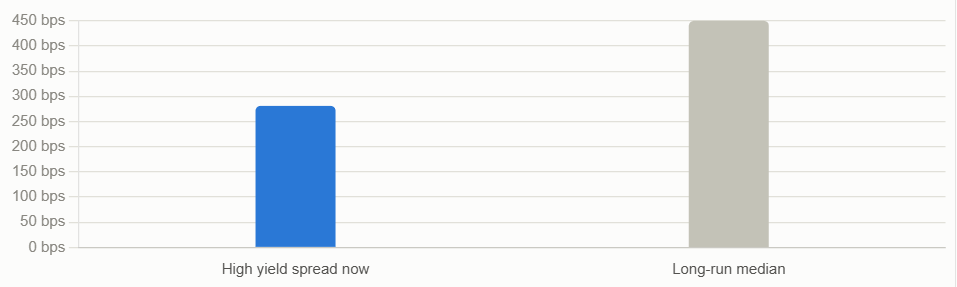
The instrument that actually settles a recession call, though, is credit, and credit has already voted. High-yield spreads sit at 281 basis points, the richest decile in the entire history of the series, against investment grade at 81. A genuinely closing financing window for capital-intensive borrowers shows up in their spreads before it shows up anywhere else. It hasn’t. Credit is priced closer to perfection than at almost any point on record.
Source: Author
Breadth agrees. The S&P 500 closed at a fresh all-time high this week, up 1.8% in a session, and the Nasdaq gained 2.6% on strength in the same AI-adjacent names the recession story had marked as casualties. Eight of eleven sectors finished green, including industrials, the sector supposedly leading the capital-goods downturn. Semiconductor names that had shed over a trillion dollars of value in the initial selloff had already recovered most of it, and the underlying data explains why: global semiconductor sales hit a record $120.6 billion in May, up 104% year over year, the fifteenth straight monthly record. That’s demand, not financing engineering.
And there’s a third, independent instrument that closes the case: the dollar. A genuine risk-off episode needs the dollar spiking alongside credit cracking, the classic flight-to-safety pair. Neither is happening. The Dollar Index just posted its worst week in three months, sliding from about 100.3 to an intraday low near 99.3, with most forecasters now looking for the mid-90s by year-end. Emerging-market currencies, the real, the rand, the peso, Asia’s export currencies, have been rallying against that weaker dollar, which is a signature of easing global liquidity reaching risk assets broadly, not a narrow rally confined to a handful of mega-cap names. Three separate instruments, credit, breadth, and the dollar, are all reading the same direction. That’s not a coincidence you should be positioned against.
The recession sequence should be demoted to a minority scenario rather than deleted outright. It reasserts if credit actually turns, or if the Hormuz de-escalation reverses and oil reclaims 88 to 90. But sized for the world it’s actually describing, it’s the tail, not the trunk.
The better use of the next eighteen months is a trade sitting one layer beneath the macro debate: dispersion inside the AI complex itself, sorted by capital discipline rather than by theme. The same week the index made new highs, two of the four hyperscale cloud companies sold off hard on their earnings, Alphabet down 5%, Meta down 8%, both after raising capital-spending guidance. The one that posted a lower headline capex number, Microsoft, rallied 14%. That’s not the market turning on artificial intelligence. It’s the market getting selective about which companies inside the buildout earn the benefit of the doubt for spending more and which get punished for it, all while the aggregate index keeps climbing. That distinction is worth more than a directional bet on the theme as a whole.
| Company | Prior 2026 guide | New guide | Move | Stock reaction |
|---|---|---|---|---|
| Alphabet | $180-190B | $195-205B | Raised | -5% |
| Amazon | ~$200B | ~$220B | Raised (partly memory prices, per Jassy) | mixed same week |
| Meta | — | ~$135-145B | Raised | -8% |
| Microsoft | ~$190B | ~$175B | Headline fell (mostly lease accounting) | +14% |
One thread underneath that dispersion deserves attention before it’s obvious. A Chinese memory manufacturer, CXMT, just made its debut in Shanghai, and the market read its capacity expansion as a real threat to memory-chip pricing. Elevated memory costs have quietly done real work this earnings season, including in at least one hyperscaler’s own explanation for why its spending guidance came in above expectations. New large-scale memory supply argues for lower input costs across the buildout over the next year, favoring the margin story over the inflation story, and it isn’t priced yet.
There’s a second, fully separate opportunity worth naming, because it has nothing to do with the AI-capex debate at all. Gold made an all-time high near $5,589 an ounce back in January, then corrected some 27% over six months as flows chased the AI trade instead. It’s now stabilizing, up roughly 4% over the past month into the low $4,000s, while the miners have not followed, Agnico Eagle down 6% on the month, Alamos and Equinox down 8% each, margins still being re-rated against a falling metal that has since turned. JPMorgan is calling for $6,000 by year-end. If that’s even directionally right, the equities haven’t repriced for the possibility at all. A metal firming while its own producers keep making new lows is the classic shape of either a bottom forming or a lagging group about to catch down, and it resolves independently of anything happening in semiconductors or Treasury term premium.

Source: Author
None of this is a call to abandon caution altogether. Credit can still turn, the dollar can still resume strengthening, and a forecast is only as good as its willingness to answer to the instruments built to test it rather than to the story that formed fastest. Right now those instruments, credit, breadth, and the dollar together, are answering with unusual unanimity: this is a broad, well-financed market with a geopolitical scare passing through it, not two economies pulling apart.




Leave a comment