
The Tape
Today is a risk-off session with an oil-supply-shock overlay, not a clean trend day.
- Oil spiking: Brent +6.5%, WTI +5.5%, heating oil +4.3%, gasoline up. This is a supply shock (transit chokepoint), not demand-led.
- Fear on: Nasdaq 100 down 1.5%, S&P down 1.0%, Russell 2000 down 3.5%, VIX +5.1%, USD +0.9%, 10Y and 30Y yields up.
- Metals and crypto red together: silver down 2.2%, platinum down 3.8%, palladium down 2.8%, copper down 1.8%, gold down 0.4%, bitcoin down 1.2%.
- Sector week: Energy +6.1% (YTD +34%, the runaway leader), Basic Materials +1.9%, Utilities +1.5%. The damage is in Communication Services down 8.1% (GOOGL down 7% on earnings) and Consumer Cyclical down 6.9% (TSLA down 14%).
- Breadth rolling over: on the 50-day window there are 137 new lows against 94 new highs. More names breaking down than breaking out. The leadership is narrow and energy-concentrated.
The collateral-liquidity matters here. While oil ripped, gold, silver, copper and bitcoin all fell together. That is the classic pattern of an oil move blowing through margin, forcing the sale of the most liquid collateral to meet the call. So today’s metals weakness is likely mechanical, not a clean fundamental signal. Same signature as the 2026-07-13 Hormuz-scare example. Whether it stays contained or spreads is the credit-plus-DXY question below.
The Clusters
Two dominant baskets plus a late-cycle value ring (52-weeks).
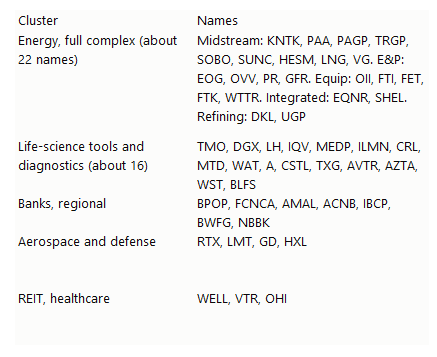
What is emerging (20-day, 134 names). This is the sharper screen, because it isolates what is being bought today. Compared to the 50-day trend, the fresh money is going somewhere specific.
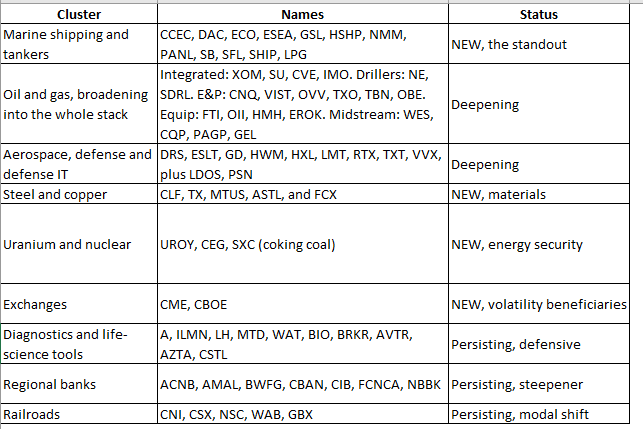
The tell of the day is marine shipping. Eleven tanker and carrier names at 20-day highs, bought up from the open, when almost none were leading a week ago. That is the purest transit-disruption trade there is: strait closed, tankers reroute around the Cape, war-risk insurance premiums spike, charter day-rates explode. LPG (gas carriers) says the same for LNG rerouting. If I want the cleanest live expression of “Hormuz is shut,” it is freight rates, and the tape just lit it up.
The second thing worth naming: the Curve 2 structural theme (uranium, nuclear, copper, steel) is already peeking through at the same time as the acute spike. That is the ideal early entry, before the eventual oil round-trip forces everyone into energy security as a theme.
The game plan
Three anchors. Liquidity is the master variable, an oil shock is a liquidity drain and a margin call on every leveraged book at once. Do not trade the move everyone can already see, trade the one it forces. And the Fed reaction function is the pivot, because this is a supply-shock inflation impulse the Fed cannot cut its way out of.
Curve 1, the shock (now to weeks): long the disruption
What pays while the strait premium is live and rising.
- US energy export and LNG. Qatari LNG gets stranded behind Hormuz, so US Gulf export is repriced as strategic. Names: LNG (Cheniere), CQP, WES, KNTK, TRGP, VG.
- Non-Gulf oil beta. Producers outside the transit chokepoint capture the price without the transit risk. Names: EQNR (Norway), CNQ and SU and IMO and CVE (Canada), VIST (Argentina), EOG, OVV, XOM. Offshore drillers NE, SDRL. Refiners DKL, UGP on crack widening.
- Shipping and tankers. The purest second-derivative. Names: the eleven-name basket above (SFL, DAC, GSL, NMM, STNG-type, plus LPG for gas carriers).
- Defense and munitions. Active conflict is multi-year resupply, not a one-day pop. Names: RTX, LMT, GD, HXL, DRS, ESLT, plus defense IT LDOS, PSN.
- Rails over trucking. Fuel spike drives modal shift to rail, plus pricing power. Names: UNP, CSX, NSC, CNI, WAB, GBX.
- Exchanges. Chaos pays the house, they monetize volume and volatility. Names: CME, CBOE.
- Long USD, long vol, short duration while the inflation impulse pushes yields up.
What gets hurt now, the short or avoid side: consumer cyclical (oil is a consumer tax, TSLA down 14% is the archetype), airlines, EM oil importers, and the reflexive leveraged-proxy unwinds, MSTR and CRCL and BMNR all red again. Long-duration growth takes the double hit of rate-up and risk-off.
Curve 2, the consequence (weeks to months): long what the shock causes
An oil shock is self-limiting, demand destruction plus a supply problem the Fed cannot fix. The 1990 and 2008 analogs end the same way: the spike breaks growth, then oil rolls over harder than it spiked (2008: 147 dollars to 30). So being long oil late is the trap, and the pivot trades are:
- Duration (long Treasuries, TLT). The moment the oil tax plus a higher-for-longer Fed visibly cracks growth, money floods duration and yields collapse. This is the single highest-conviction asymmetric bet for the next curve. Flip from short duration to long.
- Gold, buy the forced-margin dip. Today’s gold weakness is mechanical (collateral liquidation), not fundamental. Once the cascade clears, gold is the cleanest expression of geopolitical risk plus an eventually-trapped-then-easing Fed. Separating the mechanical seller from the fundamental is the entry.
- Energy security as a structural theme, not a trade. The conflict permanently reprices energy security regardless of when the spike resolves: US LNG, domestic production, and uranium and nuclear (UROY, CEG). This survives the oil round-trip, which is why it is worth building into now.
- Defense stays. Structural rearmament is a Curve 2 hold, not a Curve 1 pop.
- The mega-cap growth wreck becomes the buy, but only after the liquidity and credit event fully vents. Not yet.
The pivot signals (Curve 1 to Curve 2)
- Closure duration is everything. A brief closure is a spike-and-reverse, fade energy into strength. A sustained multi-week closure locks in the stagflation curve and makes Curve 2 real. This is the one variable I want a hard read on before sizing anything.
- Credit (HY minus IG) plus DXY together is the kill-switch. If credit cracks and the dollar spikes from a grind into a vertical move, the forced selling has gone systemic, and rotation becomes full risk-off. Stop buying dips. USD +0.9% today is a grind, not a spike.
- The demand-destruction tell. When oil stops making new highs on bad geopolitical news, the market is already pricing the recession. That is the cue to rotate from the shock trade into duration and gold.
Verdict
The 20-day up-from-open screen confirms and sharpens the thesis. Curve 1 is now unambiguous and broadening, shipping to energy to materials to defense, which also means the easy part is getting crowded. Brent +6.5% with eleven tankers up from the open is not a contrarian entry, it is confirmation. So the plan is to use shipping and energy strength as the thing I would be trimming into, while uranium, nuclear and copper are the Curve 2 positions I would be building.
The honest hole in my own reasoning: I am pattern-matching this hard to 1990 and 2008, and every oil shock feels like the big one on day one. Saudi spare capacity can partly bypass Hormuz through the Red Sea pipeline, an SPR release plus demand destruction can cap the spike faster than the tape assumes, and if the closure is measured in days rather than weeks, half of this note is a spike-and-reverse and the durable trades are only the energy-security and duration ones. So the whole thesis hinges on closure duration, and that is the number to pin down next.



Leave a Reply