The last week’s biggest winners are telling a cleaner story than the index.
This is not just a speculative AI rally. It is not simply “tech up.” And it is not only a short squeeze in forgotten small caps. The pattern running through the strongest performers is more specific: the market is beginning to reward the physical stack behind AI.
Memory. Storage. Semicnductors. Optical networking. Power. Grid. Data-center infrastructure. Compute monetization.
In other words, the market is moving from AI as software narrative to AI as industrial buildout.
That distinction matters. The first phase of the AI trade was about models and GPUs. The next phase is about everything required to keep those models running: electricity, memory bandwidth, storage, cooling, interconnects, substations, transmission, and reliable compute capacity.
The tape is starting to price that.
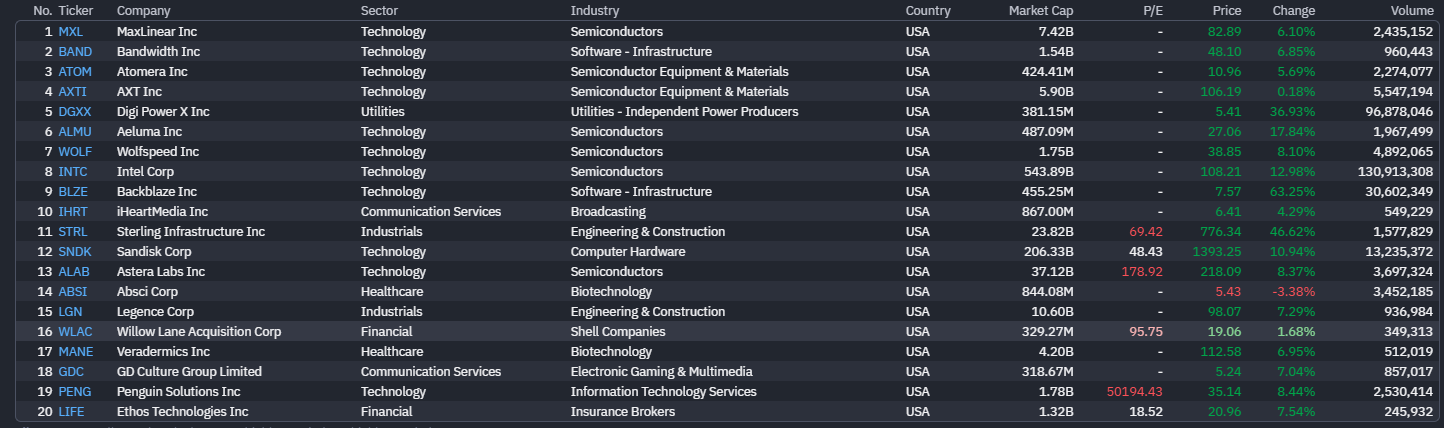
source: Finviz
The cluster is the signal
The relationships are clustering.
The winners are not randomly distributed across sectors. They are concentrated in names tied to data movement, memory, storage, semiconductors, power infrastructure, and compute-adjacent capacity. You see it in names like MU, INTC, SNDK, STX, WDC, MRVL, LITE, GFS, ON, STM, MXL, AXTI, CEVA. These are not all the same business, but they sit in the same emerging regime: AI demand increases pressure on the entire hardware stack.
That is the key market message.
The market is no longer only paying for the obvious AI front end. It is starting to pay for the second derivative: the bottlenecks that appear after the first wave of AI demand overwhelms available infrastructure.
This is why “old tech” matters. Memory, storage, optical, networking, and legacy semis were easy to ignore when investors thought AI was mainly a GPU-and-cloud story. But once inference scales, data volumes explode, workloads become persistent, and data centers become electricity hungry factories, those boring layers become strategic again.
The market is reclassifying yesterday’s cyclicals as tomorrow’s bottlenecks.
Power is becoming part of the AI trade
The second cluster is even more important.
Names tied to power-to-compute infrastructure, say miners, compute infrastructure, grid, electrical equipment, engineering and construction, are also showing up. WULF, CIFR, NBIS, DGXX, and in the broader framework names like IREN, sit in this world. Alongside them are buildout names like PWR, STRL, MYRG, PRIM, AMSC, NVT.
That is the market connecting the dots:
AI demand, compute demand, data-center demand, electricity demand, grid bottlenecks.
The constraint is moving from chips to energized megawatts.
This is exactly the framework we have been developing: AI is not just a software cycle. It is an industrial power cycle. The winners are the companies that can deliver the physical inputs required to turn electricity into tokens.
That is why the AI infrastructure trade keeps broadening into power, storage, grid, cooling, memory, and industrial construction.
The market is discovering that compute is a real-world commodity.
But not every mover is a structural winner
There is a second layer in the tape: squeeze dynamics.
Some of the strongest weekly performers are names with terrible multi-year histories, distressed charts, or heavy short interest. When those stocks move 30%, 50%, 70%, or 100% in a week, that is not always fundamental discovery. Sometimes it is positioning.
This matters because the same screen can contain two very different phenomena.
One is a durable re-rating of scarce bottleneck assets.
The other is a high-beta short squeeze in beaten-down equities.
The art is separating the two.
A real leader will hold its gains on the next market pullback. A squeeze name will give them back quickly once liquidity cools. The first becomes an investment candidate. The second is a trading vehicle.
This is where the next edge sits: not in chasing every green ticker, but in asking which names are being re-rated because their strategic value has changed.
The volume confirms participation
The volume screen adds weight to the signal.
This is not just illiquid microcaps moving on air. Some of the biggest volume names include large and liquid players like INTC, MU, SNDK, MRVL, alongside more speculative compute/power names.
That combination matters. It suggests the move is not confined to retail speculation. There is broader participation in the semis/power/infrastructure complex.
When price momentum, volume expansion, and sector clustering appear together, the signal becomes more meaningful.
That does not mean the entry is easy. In fact, the opposite is true. When a screen is full of stocks up 30%, 60%, 100% in a week, you are not early tactically. You are identifying a regime, not receiving a clean buy signal.
The right question becomes: what survives the first correction?
That is where the real leaders reveal themselves.
The investment implication
The market appears to be rotating toward a simple but powerful idea:
AI demand is real, and the bottleneck is physical.
That creates a different investment map from the one most people started with. The obvious AI trade was software, models, and GPUs. The more durable trade may be the enabling infrastructure: memory, storage, networking, power, grid, and data-center capacity.
This is the “Build, Not Bid” regime.
Investors spent the last decade bidding up financial assets. The next decade may reward companies that expand real capacity. In AI, that means the industrial supply chain behind compute. In defense, it means onshore, mission-critical production. In energy, it means grid and generation. Across all three, the recurring theme is the same: bottlenecks are becoming investable assets.
The market is beginning to price that.
What to watch next
The cleanest test is not whether these stocks keep going up every day. It is whether the cluster remains coherent.
If semis, memory, storage, power, and grid names continue to outperform together, the regime is strengthening. If only the most speculative names lead while the liquid infrastructure names fade, then this is more squeeze than structural re-rating.
The second test is how the group behaves when rates or oil rise. If higher yields immediately crush the trade, it remains mostly a duration/momentum trade. If the best names hold up, the market is telling us something more important: these companies are being valued as scarcity assets, not just growth stocks.
That is the distinction that matters.





Leave a Reply