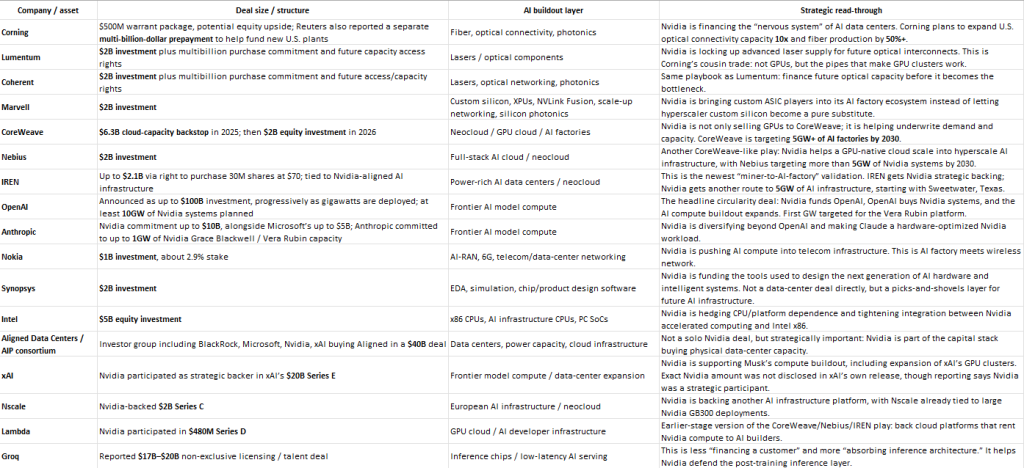
For twenty years, the market learned to value tech through software instincts: users, APIs, developers, distribution, network effects, gross margins. But AI breaks that mental model because AI is not just software. AI is throughput. And throughput is physical.
You do not scale frontier AI with a better landing page, in fact, you scale it with power, substations, cooling, fiber, lasers, HBM, packaging, networking, data halls, permits, financing, and customers willing to absorb gigantic compute commitments.
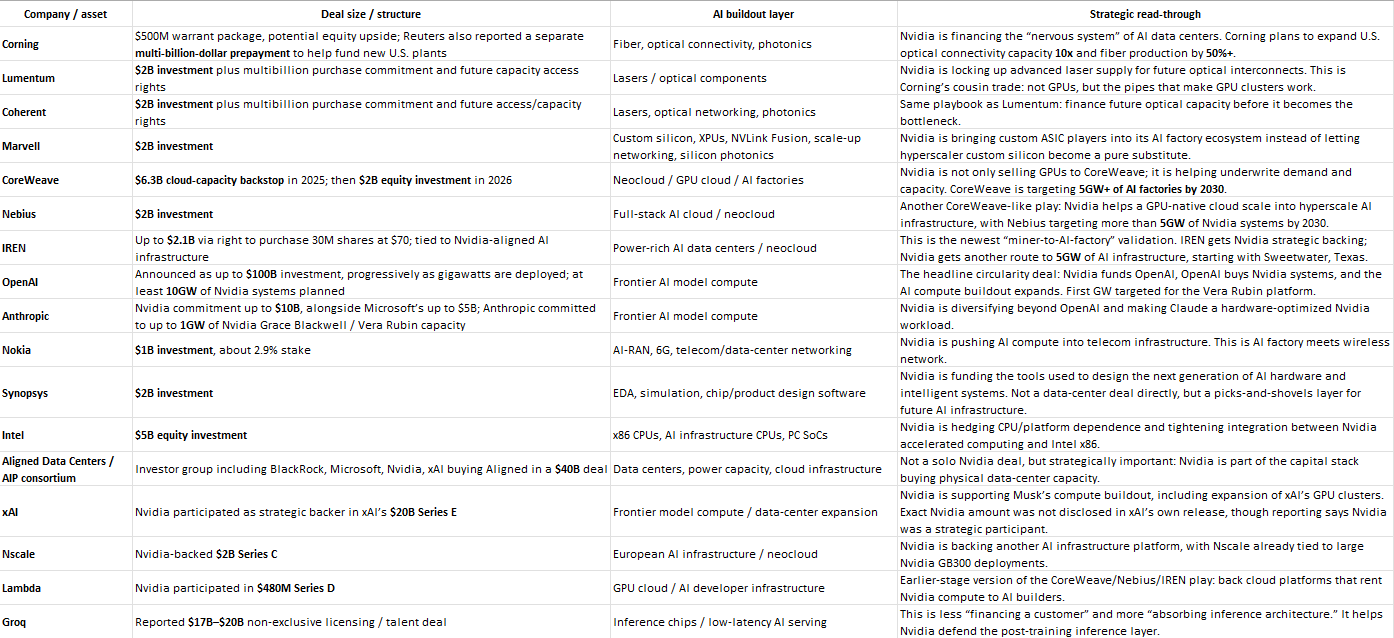
That is why these NVIDIA deals matter. The Corning deal is NVIDIA saying: if fiber becomes the choke point, the GPU roadmap slows down. So NVIDIA pre-funds the choke point before the market even understands it. Corning is expanding optical connectivity manufacturing capacity by roughly 10x and fiber capacity by more than 50%, helped by a multi-billion-dollar NVIDIA prepayment and equity-linked support.
Same with Lumentum and Coherent. These are not random optical names catching an AI halo. NVIDIA put $2B into Lumentum and $2B into Coherent, alongside purchase commitments and capacity-access rights, because large AI clusters increasingly become networking and optics problems, not just GPU problems.
That is the hidden shift.
The market keeps asking: “How many GPUs can NVIDIA sell?”
The better question is: “What has to exist for NVIDIA to sell the next trillion dollars of systems?“
And Jensen’s answer seems to be: I will finance whatever has to exist.
OpenAI needs 10GW of AI systems? NVIDIA is willing to invest up to $100B progressively as those gigawatts are deployed. Anthropic needs future compute optimized around Grace Blackwell and Vera Rubin? NVIDIA commits up to $10B and supports a path toward 1GW of compute capacity. CoreWeave needs demand confidence to fund AI cloud capacity? NVIDIA gives it a $6.3B backstop for unsold cloud capacity. IREN has power-rich infrastructure that can become AI factory capacity? NVIDIA takes a right to invest up to $2.1B as part of a deal targeting up to 5GW of AI infrastructure. Marvell could help hyperscalers build semi-custom AI infrastructure without leaving the NVIDIA ecosystem? NVIDIA puts in $2B and pulls custom silicon into NVLink Fusion.
This is constraint capture.
NVIDIA is mapping the entire AI production function and asking: where can the system break? Power? Back the data-center operator. Fiber? Fund Corning. Lasers? Fund Lumentum and Coherent. Custom silicon? Fund Marvell. Model demand? Fund OpenAI and Anthropic. Cloud absorption? Backstop CoreWeave. Power-rich AI campuses? Finance IREN.
That is why I think the right analogy is not Intel in PCs. It is closer to an industrial prime contractor crossed with a central bank for AI infrastructure.
NVIDIA is not merely supplying the gold rush. It is financing the railroads, standardizing the gauges, deciding which towns get stations, and selling the locomotives.
The big market misunderstanding is that people still talk about NVIDIA as if the only moat is CUDA. CUDA matters. It is the software gravity. But the deeper moat is becoming system coordination.
In a bottleneck economy, the winner is not always the company with the best component. It is the company that can turn chaos into a deployable system. NVIDIA has become the firm that tells the rest of the ecosystem: build around this rack, this network, this software stack, this power envelope, this deployment cadence, this roadmap.
That is an underrated form of power.
Because once you define the architecture, you define compatibility.
Once you define compatibility, you define who gets scaled.
Once you define who gets scaled, you capture rent from the entire buildout.
This is why the “circularity” criticism is both valid and incomplete. Yes, there is financial circularity risk when NVIDIA invests in customers or suppliers that buy or enable NVIDIA systems. But the industrial logic is clear: when the bottleneck is sequential deployment, capital itself becomes a tool of control. NVIDIA is not just chasing demand. It is manufacturing deployability.
The old semiconductor cycle was simple: shortage, overbuild, glut, price collapse.
The AI infrastructure cycle is more complicated. You cannot flood the market with energized, permitted, liquid-cooled, fiber-connected, HBM-equipped, optically networked AI capacity overnight. The system has too many choke points. That does not eliminate cyclicality, but it stretches it. Scarcity rotates before it disappears.
First GPUs are scarce.
Then HBM is scarce.
Then packaging is scarce.
Then power is scarce.
Then transformers are scarce.
Then optical interconnect is scarce.
Then capital is scarce.
NVIDIA’s genius is that it does not wait for the bottleneck to become obvious. It moves before the market’s spreadsheet updates.
They see it better than anyone because they are in the eye of the hurricane. That is the real story.
NVIDIA is building the AI stack as if it were a national industrial project, except the coordination layer is corporate, not governmental.
And that creates a very different investment framework. The question is no longer just who has AI exposure? Everybody has AI exposure now. The question is:
Who controls the next constraint?
That is the map.
Power-ready sites matter more than vague “MW pipelines.”
Optics matter more than generic “data center components.”
HBM and packaging matter more than chip-design slides.
Permitted land matters more than theoretical capacity.
Take-or-pay contracts matter more than press releases.
Balance-sheet depth matters more than TAM language.
In this world, the market should pay a premium for companies that remove schedule risk. Because in AI infrastructure, schedule risk is valuation risk.






Leave a comment